Navigating Support Animal Laws in the US: Service Dogs, ESAs, and Your Rights
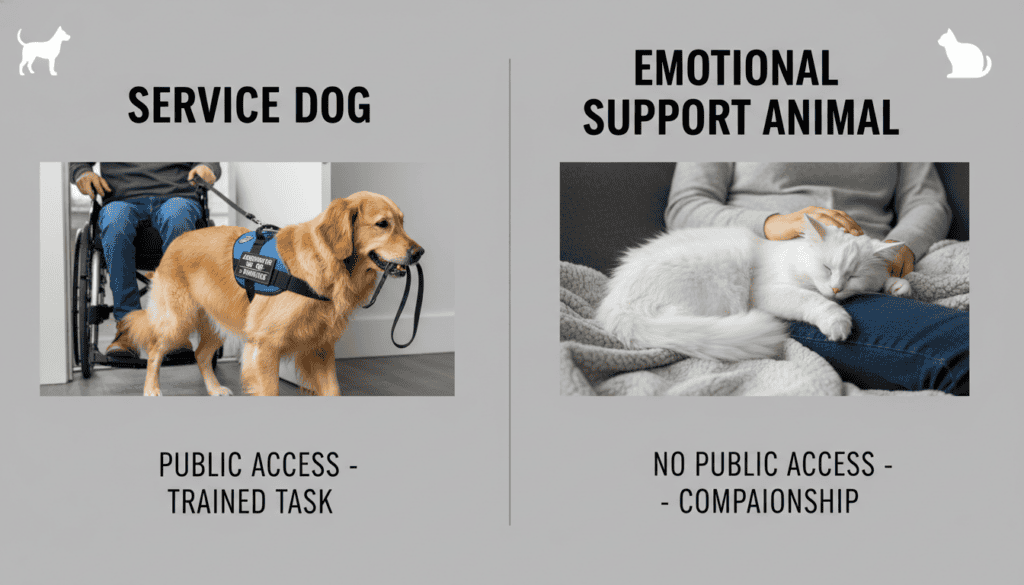
In recent years, the sight of a dog in a coffee shop, a cat in a carrier at the airport, or even a miniature horse on public transit has become more common. These are support animals, and their growing presence highlights a widespread need for assistance and companionship. However, this increased visibility has also led to significant confusion. What is the difference between a service dog and an emotional support animal? What are their legal protections? This article aims to demystify the complex web of laws, rights, and responsibilities surrounding service animals and emotional support animals (ESAs) in the United States, providing clarity for individuals with disabilities, business owners, and the general public alike.
- Service Animals vs. ESAs: Service animals are specifically trained to perform tasks for a person with a disability, while Emotional Support Animals (ESAs) provide comfort and companionship.
- Governing Laws: The Americans with Disabilities Act (ADA) governs service animals, granting them broad public access. The Fair Housing Act (FHA) is the primary law protecting ESAs, but only in housing situations.
- Public Access Rights: Service animals are legally permitted in most public places, including restaurants, stores, and hospitals. ESAs do not have these same public access rights.
- Training Requirements: Service animals must be trained to perform a specific task related to a disability, though professional training is not required. ESAs require no special training.
- Documentation: Businesses can ask two specific questions to verify a service animal but cannot require documentation. For an ESA in a housing context, a landlord can request a letter from a licensed mental health professional.
- Travel Rules: Following changes to the Air Carrier Access Act, most airlines no longer accommodate ESAs for free and treat them as regular pets. Service animals retain their flying privileges.
Service Animals Under the Americans with Disabilities Act (ADA)
When it comes to laws for service animals, the Americans with Disabilities Act (ADA) is the primary federal statute. It provides a clear, and notably specific, definition of what constitutes a service animal, setting a high bar that distinguishes them from other types of support animals. Understanding these service dog guidelines is the first step in appreciating their unique role and legal standing.
Defining a Service Animal: Under the ADA, a service animal is defined as a dog that has been individually trained to do work or perform tasks for an individual with a disability. In some cases, a miniature horse may also qualify. The critical element is the specific, task-oriented training directly related to the person’s disability. This can include a wide range of duties, such as a dog guiding a person who is blind, a dog alerting a person who is deaf, or a dog trained to detect the onset of a seizure. The ADA explicitly states that animals whose sole function is to provide emotional support, comfort, or companionship do not qualify as service animals.
ADA Protections and Public Access: The disability act for service animals grants them broad access rights. State and local governments, businesses, and non-profit organizations that serve the public must generally allow service animals to accompany people with disabilities in all areas where the public is normally allowed to go. This includes restaurants, hotels, grocery stores, and hospitals. Staff are legally permitted to ask only two questions: (1) “Is the dog a service animal required because of a disability?” and (2) “What work or task has the dog been trained to perform?” They cannot ask about the person’s disability, require medical documentation, or ask for a demonstration of the task. A service animal can only be legally excluded if it is out of control and the handler does not take effective action to control it, or if it is not housebroken.
Training and Documentation: A common misconception is that service dogs must be professionally trained or certified. The ADA does not require this. An individual with a disability has the right to train their own service animal. Furthermore, there is no legal requirement for service animal documentation, registration, or for the animal to wear a special vest or harness. These items are optional and do not confer any legal status. The legitimacy of a service animal rests entirely on its training to perform a specific task for a person with a disability.
Meet Your Florida-Licensed ESA Letter Provider
Jay Charboneau MS, LMHC, CAP
Licensed Mental Health Counselor – MH15843
Issue Date – 03/26/2018
Renewal Date – 03/31/2027
Phone Number: (727)344-9930
Email: jaycharboneau@gmail.com

About Jay
Hi, I am Jay Charboneau. I live, work, and practice in Saint Petersburg Florida. I am an educator and lifelong advocate of the rights of those suffering from mental health disorders. As a dog lover myself, I understand the emotionally soothing and healing benefits of having your pet with you. Don’t hesitate to call me if you have any questions about your mental health or an emotional support animal.
ESA Letters Across Florida
Florida Pet ESA serves clients statewide, including:
Emotional Support Animals: Laws, Rights, and the Fair Housing Act
While the ADA sets strict guidelines for service animals, a different set of laws applies to Emotional Support Animals (ESAs). These animals play a crucial role for many individuals, but their legal protections are more limited and context-dependent. The primary law governing ESAs is the Fair Housing Act (FHA), which addresses their right to live with their owners, even in housing with “no-pet” policies.
Defining an Emotional Support Animal (ESA): An ESA is an animal that provides a therapeutic benefit, such as comfort, companionship, and alleviation of symptoms, to an individual with a mental or emotional disability. Unlike service animals, ESAs are not required to have any specific task training. Their very presence is what mitigates the symptoms of the disability. Any common domestic animal can potentially serve as an ESA.
Fair Housing Act (FHA) Protections: The most significant legal protection for ESAs comes from the FHA. This act requires housing providers to make “reasonable accommodations” for individuals with disabilities. This means a landlord or housing authority must allow a tenant to keep an ESA, waiving any no-pet rules or pet-related fees, if the animal is necessary for the person to have an equal opportunity to use and enjoy the dwelling. A housing provider can deny the request only under specific circumstances, such as if the animal poses a direct threat to the health and safety of others or would cause substantial physical damage to the property.
Air Travel and Public Access: It is crucial to note that the laws for ESA animals do not grant them the same public access as service animals. Recent changes to the Air Carrier Access Act (ACAA) mean that airlines are no longer required to accommodate emotional support animals, and most now treat them as standard pets subject to pet fees and regulations. Similarly, ESAs are not automatically allowed in restaurants, stores, or other public places that do not permit pets.
Requirements for an ESA: To qualify for protection under the FHA, an individual must typically provide documentation to the housing provider. This takes the form of a legitimate letter from a licensed mental health professional (LMHP), doctor, or other medical professional. This letter should state that the individual has a disability and that the animal provides a disability-related therapeutic benefit. Landlords can request this verification if the disability is not readily apparent.
Key Differences: Service Animals Versus Emotional Support Animals
The distinction between a service animal and an emotional support animal is one of the most misunderstood areas of disability rights law. While both types of animals provide invaluable assistance, their roles, training, and legal protections are fundamentally different. Understanding these differences is essential for both animal handlers and the public to ensure everyone’s rights are respected.
Purpose and Training: The primary difference lies in their function. A service animal is a highly trained worker. It must be able to perform specific tasks directly related to its handler’s disability—actions it wouldn’t perform otherwise. An emotional support animal, on the other hand, is a companion. Its role is to provide comfort and emotional stability through its presence, and it does not require any specialized training to perform tasks.
Legal Protections and Access: This is where the distinctions have the most practical impact. Service animals are protected by the ADA, which grants them broad access to virtually all public spaces where their handler is allowed. Emotional support animals do not have this right. Their main legal protection comes from the Fair Housing Act, which allows them to live with their owner in most housing situations, regardless of pet policies. An ESA has no legal right to enter a grocery store, a restaurant, or a movie theater that prohibits pets.
Documentation Requirements: The verification process for each animal is also distinct. For a service animal, staff in a public place can only ask the two legally prescribed questions about the animal’s status and task. They cannot ask for or require any form of certification or documentation. For an ESA, a housing provider is entitled to request a letter from a healthcare provider verifying the need for the animal as a reasonable accommodation for a disability. It’s important to recognize that online “registries” or “certifications” for either type of animal hold no legal weight.
Consequences of Misrepresentation: Falsely claiming a pet is a service animal is a growing problem with serious ethical and legal consequences. It undermines the legitimacy of true service animals and can create public safety issues. Many states have enacted laws that make it a crime to fraudulently represent a pet as a service animal, with penalties that can include fines and even jail time.
Understanding Your Rights and Responsibilities with Support Animals
Navigating the world of support animals involves more than just knowing the laws; it requires a balance of asserting rights and upholding responsibilities. Whether you are an individual with a disability, a business owner, or a housing provider, understanding your role is key to fostering a respectful and compliant environment for everyone.
For Individuals with Disabilities: If you have a service animal or an ESA, know your rights under the ADA and FHA. If you encounter an access issue with your service animal, calmly and respectfully explain the law. It’s often helpful to carry a card that outlines the two questions staff are legally allowed to ask. For legal assistance or more detailed information, you can consult resources from the U.S. Department of Justice’s ADA Information Line, the Department of Housing and Urban Development (HUD), or non-profit advocacy groups. Relevant government or non-profit organization links include ADA.gov, HUD’s page on assistance animals, the Bazelon Center for Mental Health Law, and the Disability Rights Education & Defense Fund (DREDF).
For Businesses and Housing Providers: Compliance with the ADA and FHA is not just a legal obligation but also a matter of good customer service and ethical practice. It’s crucial to train staff on the correct protocol for interacting with individuals who have service animals. Specifically, they should only ask the two permitted questions and never discriminate. For housing providers, understanding the concept of “reasonable accommodation” for ESAs is essential to avoid discrimination complaints.
Responsible Animal Ownership: A critical, though sometimes overlooked, aspect of these laws is the responsibility of the animal’s handler. A support animal, whether a service animal or an ESA, must be under control at all times. This means it should be harnessed, leashed, or tethered unless these devices interfere with its work, in which case it must be under voice or signal control. The handler is also responsible for the animal’s hygiene and for cleaning up after it. An animal that is disruptive or aggressive can be asked to leave, regardless of its status.
Frequently Asked Questions About ESAs in Florida
No. Under the Fair Housing Act, assistance animals are not considered pets. Therefore, landlords cannot charge pet fees or deposits for them. However, they can charge a tenant for any damages caused by the animal.
No. The ADA does not require service animals to wear any special identification like a vest, ID tag, or specific harness. This is a personal choice of the handler.
The handler is always responsible for any damage caused by their support animal. This applies in public accommodations, housing, and any other setting.
No. The ADA and FHA do not allow for breed restrictions. A service animal or ESA cannot be denied based on breed, size, or weight. The decision to exclude an animal must be based on its individual behavior and whether it poses a direct threat.