I’m Jay Charboneau, a licensed mental health counselor in St. Petersburg (Florida license MH15843). Some of the hardest calls I get start the same way: “My landlord says my dog has to go.” I’m a dog person myself [— my dog, NAME, is usually asleep under my desk while I work], so I know what that animal means to you. This guide walks you through getting a legitimate ESA letter in Florida, the same way I’d explain it if you were sitting in my office.
The short answer: you need an evaluation with a licensed mental health professional who has personal knowledge of your condition. If they decide your animal helps with symptoms of a mental or emotional disability, they write a letter you give to your housing provider. In Florida, that evaluation can happen in person or by telehealth.
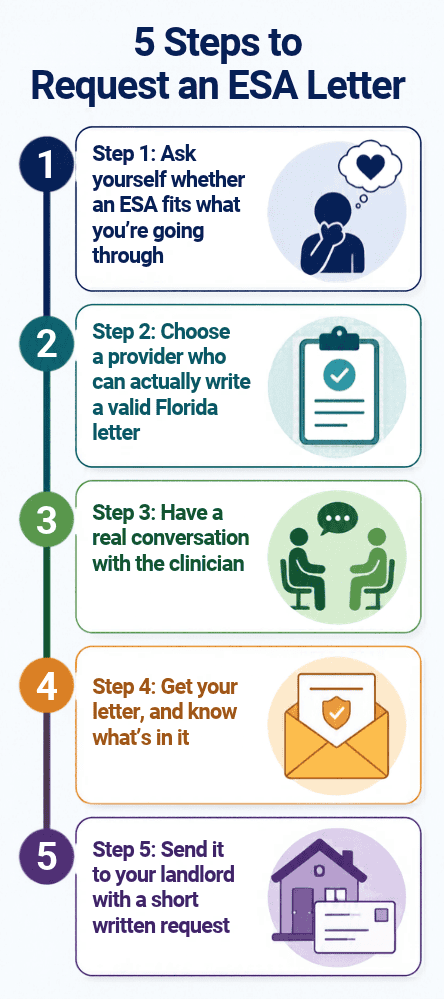
Step 1: Ask yourself whether an ESA fits what you’re going through
An ESA letter isn’t for everyone who loves their pet. Under the Fair Housing Act, it’s for people with a condition that substantially limits a major part of daily life, like sleeping, working, concentrating, or caring for yourself. Anxiety, depression, PTSD, panic disorder and ADHD are some of the conditions I see most often. If you’re not sure, read What Conditions Qualify for an ESA or just call me and ask.
The animal doesn’t need any training. Its job is to be there. That calm weight on the couch at 2 a.m., or the reason you get out of bed to go for a walk, is exactly what we’re talking about.
Step 2: Choose a provider who can actually write a valid Florida letter
Florida law (§760.27) says a letter is reliable when the practitioner has personal knowledge of your disability and is working within their scope of practice. In plain terms:
- A Florida-licensed provider (counselor, social worker, psychologist, psychiatrist, and so on) can evaluate you in person or by telehealth.
- An out-of-state provider generally must have seen you in person at least once. This trips up a lot of people who move here; see Moving to Florida With Your ESA.
- A website that “approves” you from a questionnaire alone is not personal knowledge. See How to Avoid ESA Letter Scams.
You can confirm any Florida license, including mine, on the Florida Department of Health license lookup. I’d encourage you to do that with anyone you hire.
Step 3: Have a real conversation with the clinician
When you meet with me, we talk. I’ll ask what you’ve been dealing with, how it affects your day, and what changes when your animal is with you. It isn’t an interrogation, and you don’t need to prove anything with paperwork. [Add: typical length and format, e.g. “Most evaluations take about 20 to 30 minutes by phone or video.”]
Florida law doesn’t set a minimum number of sessions or a required length of treatment. If a landlord tells you that you need “six months of therapy” first, that rule isn’t in the law.
I also want to be honest with you: I don’t write a letter for everyone who asks. If I don’t believe an ESA is part of what helps you, I’ll tell you, and we’ll talk about what might. That honesty is what makes my letter worth something when a landlord calls to verify it.
Step 4: Get your letter, and know what’s in it
A solid Florida ESA letter includes:
- The clinician’s letterhead, license type, license number and state.
- The date it was written.
- A statement that you have a disability, without naming the diagnosis.
- A statement that your specific animal helps with one or more symptoms of that disability.
- Each animal, if you have more than one, and the need for each.
- The clinician’s signature and contact information for verification.
Your diagnosis stays private. Florida law says a housing provider can’t ask for your diagnosis, its severity, or your medical records.
Step 5: Send it to your landlord with a short written request
Email is fine. Say you’re requesting a reasonable accommodation to live with your emotional support animal, and attach the letter. Keep a copy of everything you send.
Your landlord may have a standard process or portal, and it’s easiest to use it. But Florida law says they can’t require a specific form or a notarized letter, and they can’t deny you just because you didn’t use their process. They can ask for proof that your animal is licensed and vaccinated as your county requires, so have those records ready.
What your landlord can and can’t do
| Your landlord CAN | Your landlord CAN’T |
|---|---|
| Ask for reliable documentation if your disability isn’t obvious | Charge a pet deposit, pet rent or pet fees |
| Ask about the need for each animal if you have more than one | Ask for your diagnosis or medical records |
| Require proof of licensing and vaccinations | Require a specific form or a notarized letter |
| Deny an animal that’s a direct threat no other accommodation can fix | Treat an online registry or certificate as enough proof |
| Hold you responsible for any damage your animal causes | Refuse a Florida telehealth provider’s letter just because it was telehealth |
If your request is denied anyway, read What to Do If Your Landlord Denies Your ESA Letter. I’m also happy to take a verification call from your landlord.
Keeping your letter current
Florida law doesn’t put an expiration date on ESA letters. Many landlords still want one dated within the last 12 months, especially at lease renewal. More on that in ESA Letter Expiration.
Let’s talk
If your animal is part of what keeps you steady, you deserve to keep them at home with you. I’m glad to answer questions before you commit to anything. Call me at (727) 344-9930, or get started here. Pricing is on the pricing page.
— Jay Charboneau, MS, LMHC, CAP
Frequently Asked Questions About ESAs in Florida
Yes, as long as the clinician is licensed in Florida and actually evaluates you. Florida law specifically recognizes telehealth providers.
No. Licensed counselors, clinical social workers, marriage and family therapists and psychologists can all write one, if they have personal knowledge of your condition.
I take the time to do each evaluation properly, so most ESA letters are ready in 5 to 7 days, and up to 10 during busy stretches.
Yes. Any common household animal can be. See What Animals Qualify as an ESA.
No. ESA protections are about housing. Public access is for trained service animals; see ESA Letter vs. Psychiatric Service Dog.



Are you ready to get your ESA Letter Florida?
Meet Your Florida-Licensed ESA Letter Provider
Jay Charboneau MS, LMHC, CAP
Licensed Mental Health Counselor – MH15843
Issue Date – 03/26/2018
Renewal Date – 03/31/2027
Phone Number: (727)344-9930
Email: jaycharboneau@gmail.com

About Jay
Hi, I am Jay Charboneau. I live, work, and practice in Saint Petersburg Florida. I am an educator and lifelong advocate of the rights of those suffering from mental health disorders. As a dog lover myself, I understand the emotionally soothing and healing benefits of having your pet with you. Don’t hesitate to call me if you have any questions about your mental health or an emotional support animal.
ESA Letters Across Florida
Florida Pet ESA serves clients statewide, including: